
Every year more international students choose Turkey for their degree. The country offers degrees that fit into the European Higher Education Area, hundreds of English-taught programs, competitive tuition and a student life that few cities can match — especially in Istanbul. Here are the main reasons students choose Turkey, and what to check before you decide.
Why study in Turkey: quick facts
- Around 360,000 international students study in Turkey, from 198 countries.
- Turkish degrees follow the European Higher Education Area (Bologna) structure.
- Private universities offer many programs fully taught in English.
- Students can choose between a fully funded government scholarship and tuition discounts at private universities.
- You can compare fees in our cost of studying in Turkey guide.
1. Degrees that fit the European system
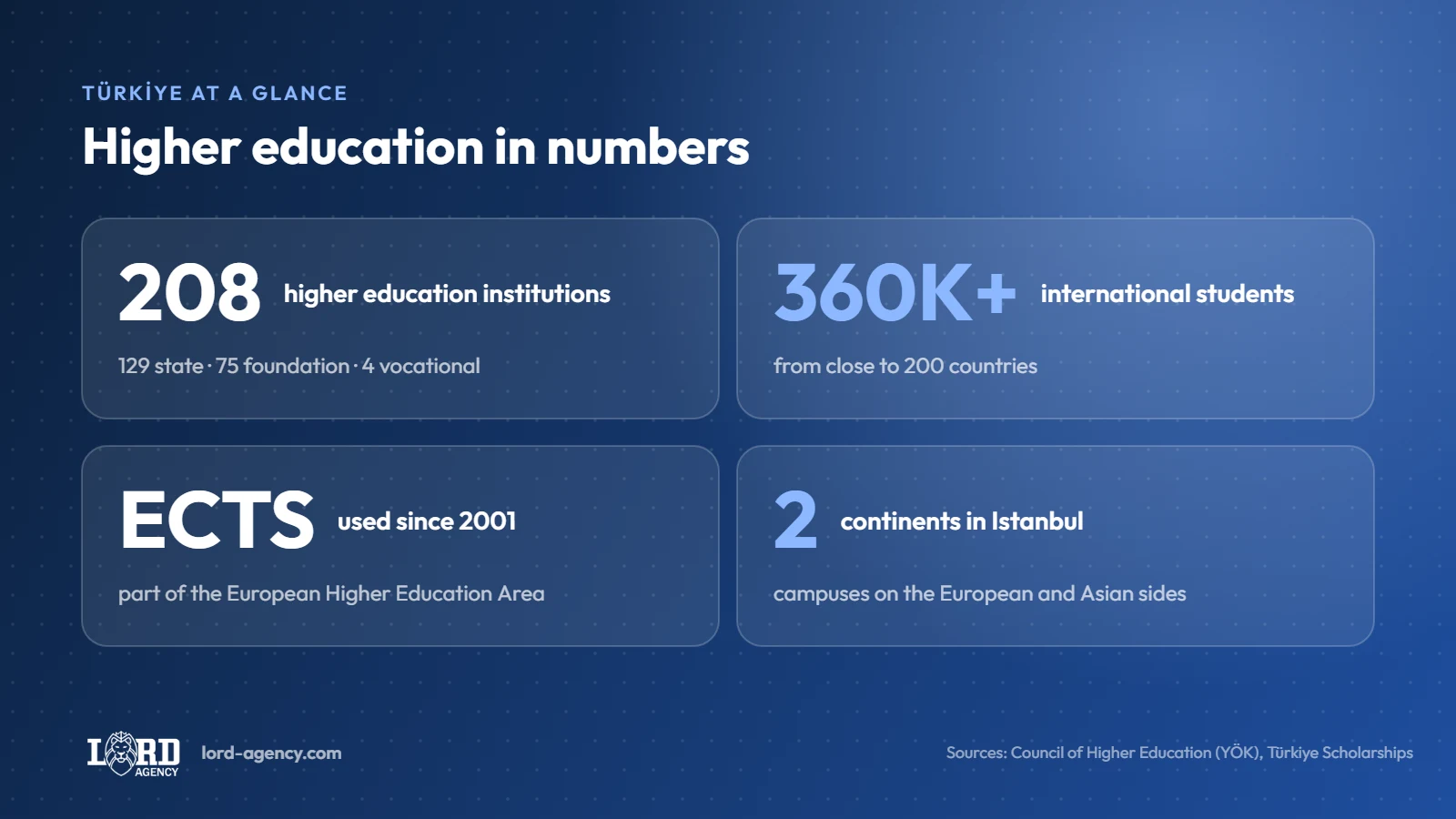
Turkey is part of the European Higher Education Area and Turkish universities have used the European Credit Transfer and Accumulation System (ECTS) since 2001 as part of the Bologna Process. Credits earned in Turkey are therefore easier to transfer to other ECTS countries, and graduates receive a Diploma Supplement that explains their degree in a standard European format.
Recognition in your home country still depends on local rules. If you plan to work in a regulated profession such as medicine, dentistry or pharmacy, check the requirements with the relevant authority before you apply.
2. A wide choice of universities and English-taught programs
According to the Council of Higher Education (YÖK), Turkey has 208 higher education institutions, including 75 foundation (private) universities. Private universities in Istanbul offer English-taught programs in fields such as medicine, dentistry, engineering, computer science, business and psychology.
Some universities are especially strong in health sciences and run their own hospitals — for example Istanbul Medipol University and Acıbadem University — while others, such as Özyeğin University and Bahçeşehir University, are popular for engineering and business.
3. Competitive tuition and living costs
Tuition at Turkish private universities is often lower than at comparable universities in the UK, the US or Australia, and many universities offer instalment plans. Fees vary widely by university and field: some programs cost a few thousand US dollars a year, while medicine at some universities costs more than 20,000 euros a year. You can compare current fees on our program search.
Living costs depend heavily on the city and your lifestyle. Mastersportal estimates roughly €400–650 per month for students across Turkey; Istanbul is the most expensive city, so plan a higher budget there, especially for accommodation.
4. Scholarships and tuition discounts
There are two main types of funding:
- University scholarships – private universities often give tuition discounts based on your grades or exam scores, usually decided when you are accepted.
- Government scholarships – Türkiye Scholarships is a fully funded program with its own yearly application round. About 15,000 international students currently hold this scholarship.
Not sure which one fits you? Read Türkiye Burslari vs private scholarships for a side-by-side comparison.
5. Istanbul: one city, two continents
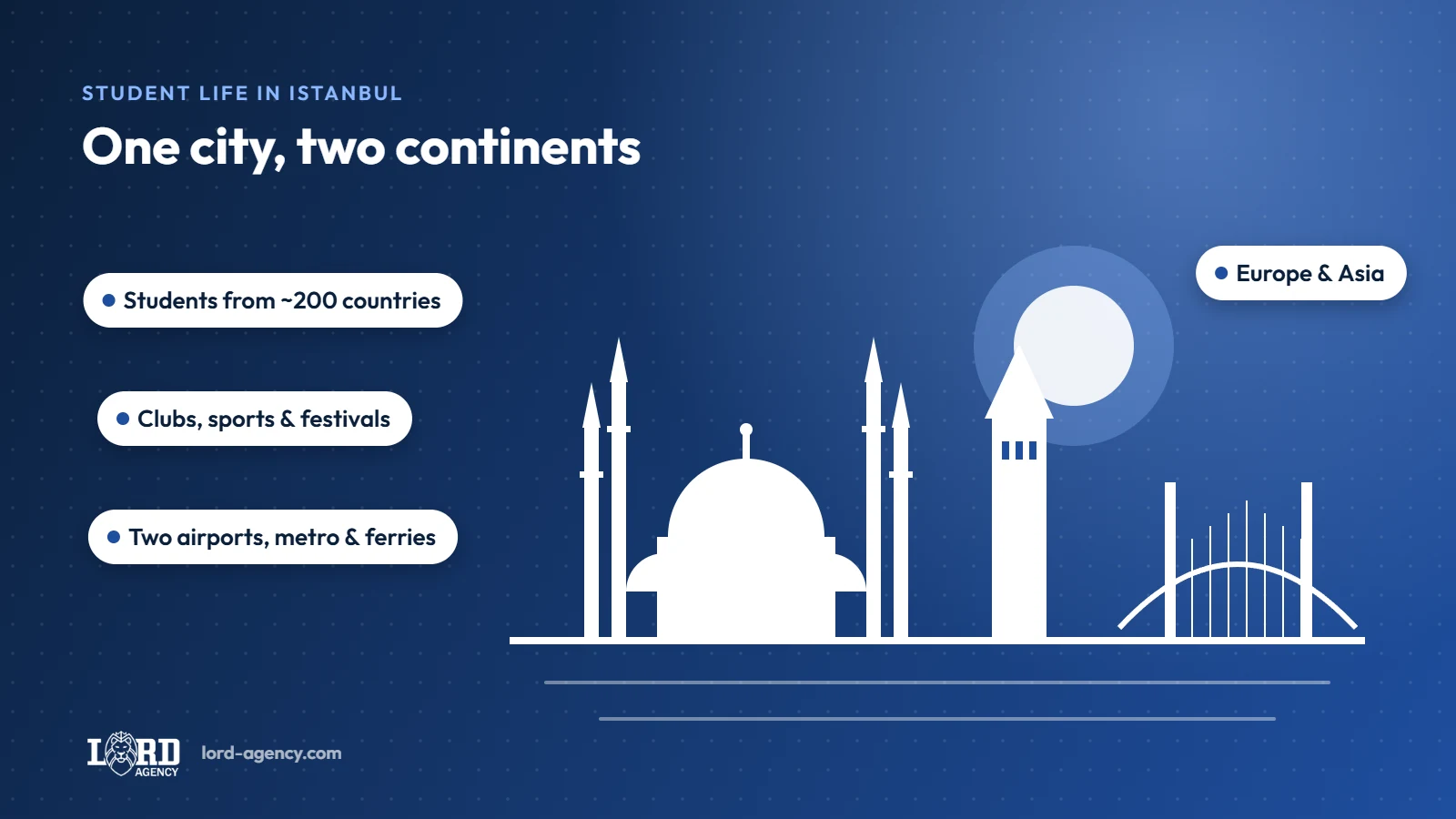
Istanbul sits on both sides of the Bosphorus, so you can live in Europe and study in Asia — or the other way round. Two international airports connect the city to the Middle East, Europe, Central Asia and Africa, and the metro, Marmaray and ferries make it easy to get around.
6. A diverse student community
Türkiye Scholarships reports around 360,000 international students in the country, and YÖK says they come from 198 countries. On campus you will find student clubs, sports teams, festivals and international student offices that help with everything from orientation to residence permits.
7. Practical experience and career options
Many programs include internships, and universities with their own hospitals give health students early clinical exposure. Learning some Turkish while you study is a real advantage if you want to work in Turkey after graduating. Work rules for international students are strict, so check with your university’s international office before taking a job.
Is studying in Turkey right for you?
Turkey is a strong choice if you:
- want an English-taught degree at a lower cost than in many Western countries
- prefer direct admission based on your school grades
- are looking for a university with its own hospital for medicine or health sciences
- want to live in a large, international city close to home
Frequently asked questions
Are Turkish university degrees recognised in Europe?
Turkey is part of the European Higher Education Area and uses ECTS, which helps with recognition and credit transfer. Recognition for regulated professions is decided by each country, so check before you apply.
Can I study in English in Turkey?
Yes. Private universities in Istanbul offer many English-taught bachelor’s, master’s and PhD programs. If you do not have an English certificate, you can usually take an English preparatory year.
Do I need to speak Turkish?
Not for English-taught programs. Learning basic Turkish still makes daily life easier and helps with internships.
How do I apply?
Follow our step-by-step guide to applying to Turkish universities, or ask an advisor to check your options.
Next steps
- Compare our partner private universities in Istanbul.
- Search programs, tuition fees and deposits in one place.
- Read next: How to apply to Turkish universities, step by step
- Request a free consultation with a Lord Agency advisor.
Free download
Get the 2026–27 fee list for 70+ universities
Bachelor's starting fees for every partner university in Turkey and North Cyprus, plus medicine, dentistry and pharmacy fees, updated from our student portal. Save it as a PDF and compare at home.
- 70+ private universities
- Fees per year in one table
- Updated live, not a 2024 PDF
Further reading: 2026–2027 tuition fees by university · student dorm prices in Istanbul and Famagusta · private university discounts and scholarships