
If you want to apply to study in Turkey, the process is simpler than most students expect. Private (foundation) universities in Istanbul accept international applicants directly, many programs are taught in English, and almost everything can be done online until you land. This guide walks you through each step — from choosing a program to applying for your student residence permit — so you know exactly what to prepare and when.
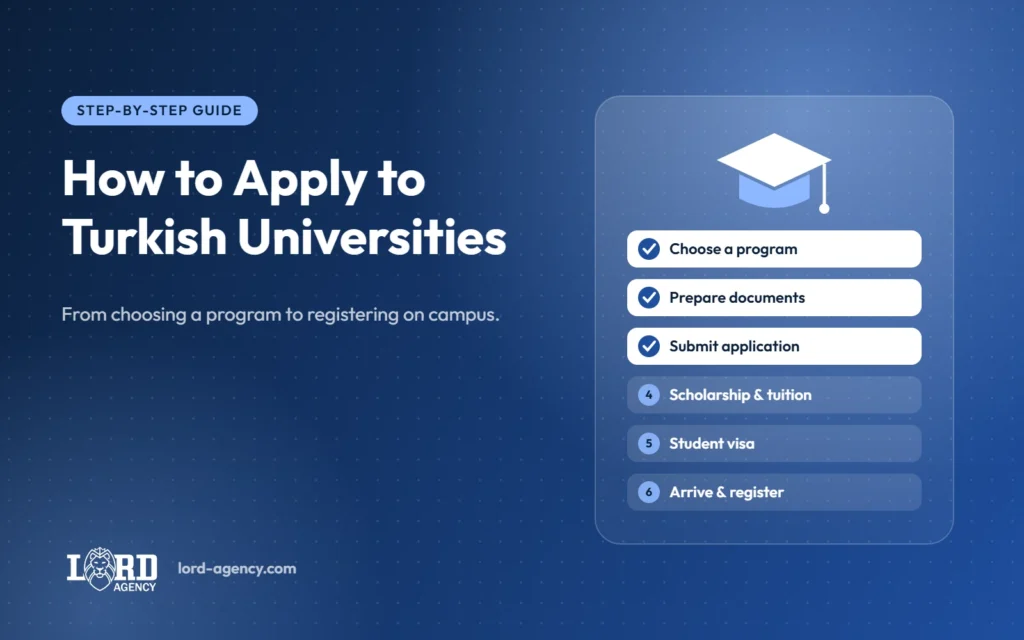
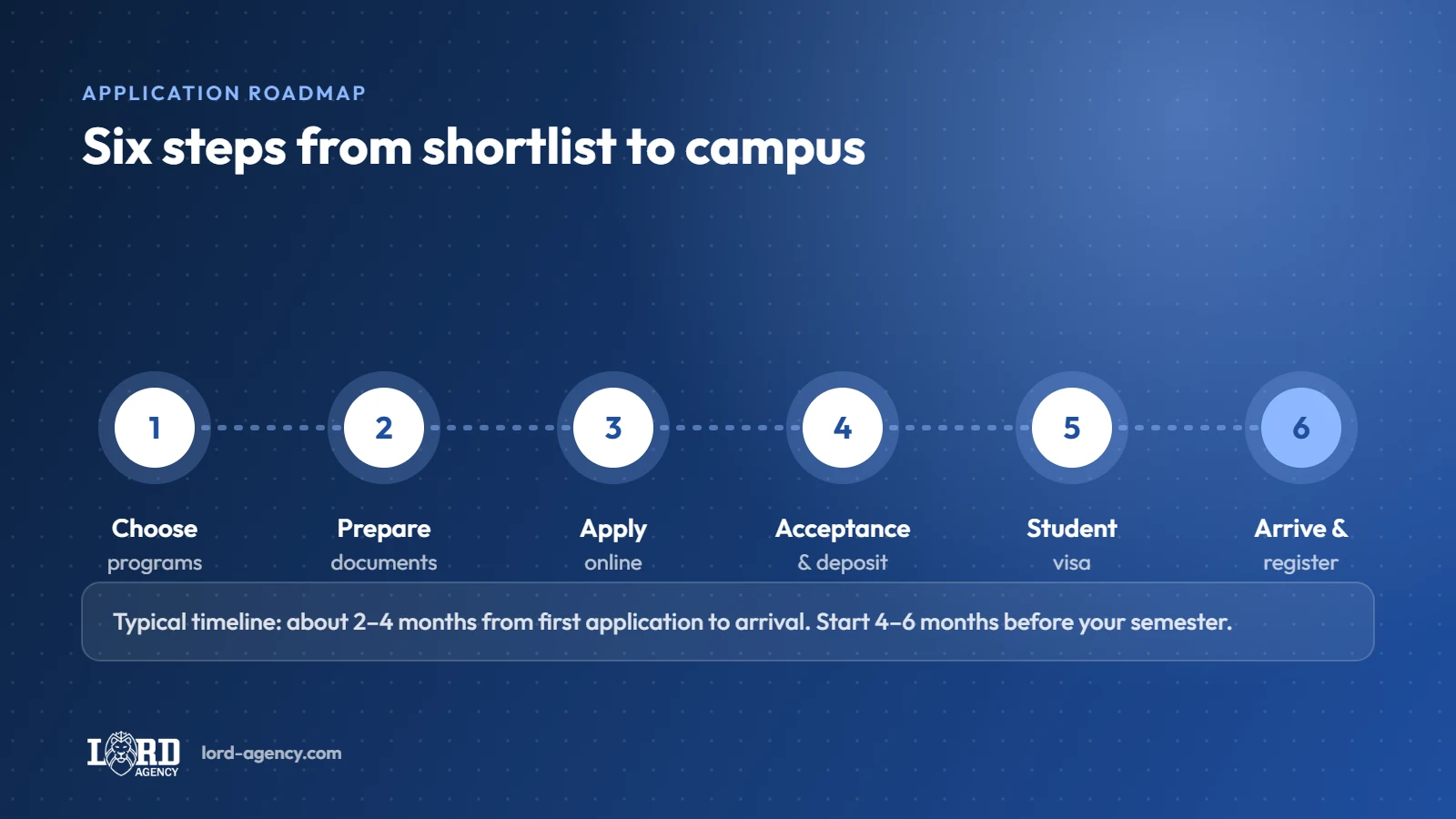
In short: choose your programs → prepare your documents → apply online → accept your offer and pay the deposit → get a student visa → arrive, register and apply for your residence permit.
1. Choose your university and program
Turkey has 208 higher education institutions: 129 state universities, 75 foundation (private) universities and 4 foundation vocational schools, according to the Council of Higher Education (YÖK). For most international students, private universities in Istanbul are the most practical route — admission is based on your previous grades and a wide range of programs is taught in English.
When you compare programs, check:
- Language of instruction – English, Turkish or partly English. Turkish-taught programs usually require a Turkish language certificate (such as TÖMER) or a Turkish preparatory year.
- Tuition and deposit – fees vary widely by university and field. Medicine and dentistry are the most expensive programs.
- Recognition – make sure the degree is recognised where you plan to work, especially for regulated professions such as medicine, dentistry, pharmacy and law.
- Campus and location – Istanbul campuses are spread across the European and Asian sides, so travel time matters.
You can compare fees and deposits on our program search page or browse our partner universities, such as Istanbul Medipol University and Bahçeşehir University.
Tip: shortlist three to five programs instead of one. Popular English-taught programs such as medicine, dentistry and software engineering can fill their international quotas early.
2. Check the admission requirements
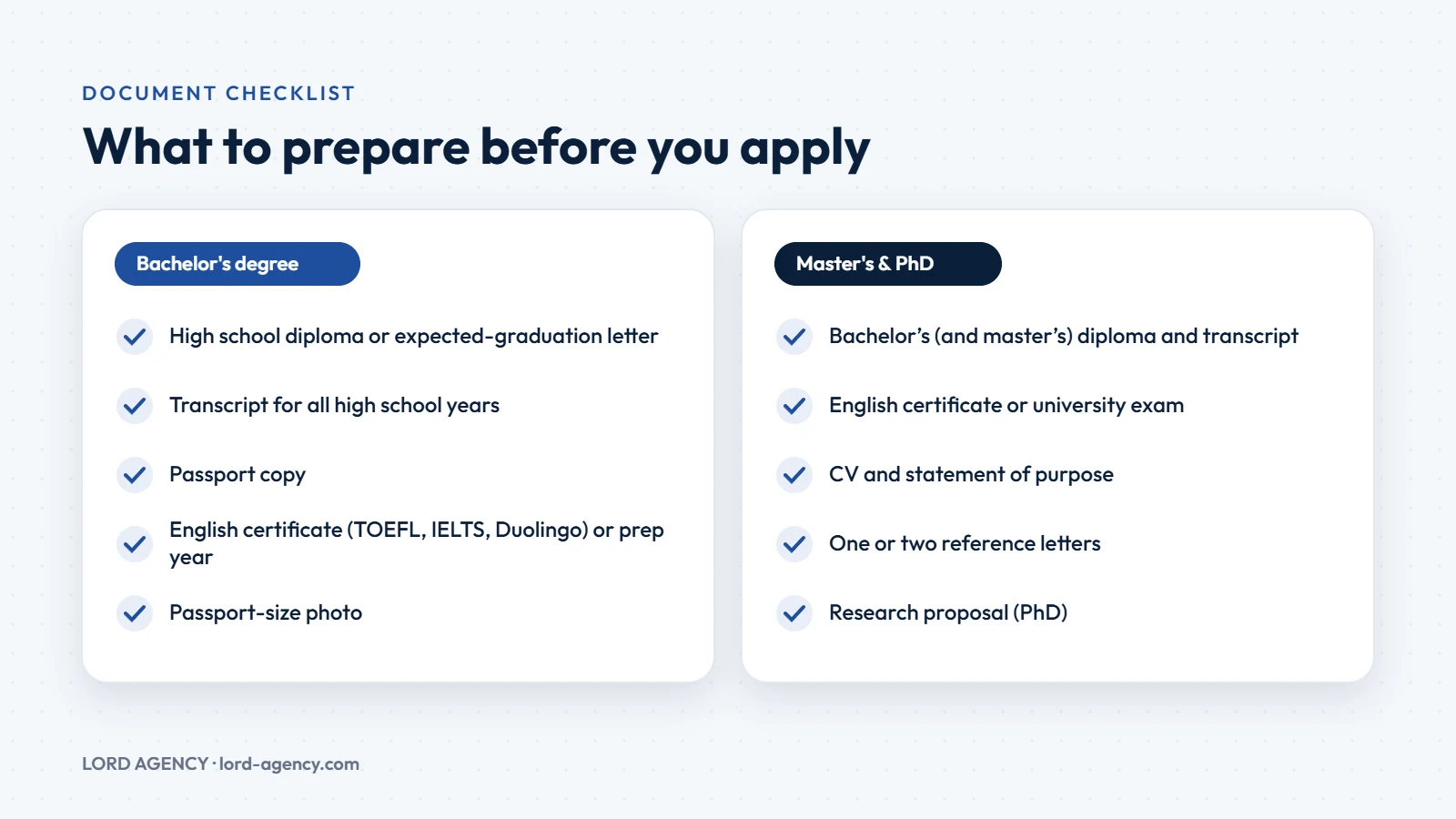
Each university sets its own criteria, but the core documents are similar.
Bachelor’s degree
- High school diploma, or a letter of expected graduation if you are in your final year
- Transcript covering all high school years
- Passport copy and a passport-size photo
- English proficiency certificate (TOEFL iBT, IELTS, Duolingo or the university’s own exam) for English-taught programs
Some competitive programs also ask for SAT, YÖS or other exam scores, but many private universities admit international students on high school grades alone.
Master’s and PhD
- Bachelor’s diploma and transcript (and master’s documents for PhD applicants)
- English proficiency certificate or the university’s English exam
- CV and statement of purpose
- One or two reference letters
- ALES, GRE or GMAT scores for some programs, and a research proposal for PhD applicants
Documents that are not in English or Turkish must be translated. Some universities also ask for notarised or apostilled copies when you register.
No IELTS or TOEFL yet? Most English-taught programs offer an English preparatory year. You can be admitted, take the university’s proficiency exam on arrival and start your degree once you pass.
3. Submit your application
Applications are made online, either on the university’s international admissions portal or through an authorised representative such as Lord Agency.
- Create your account and enter your personal and education details.
- Upload your documents as clear scans (PDF or JPG).
- Choose your programs – most universities let you list several options.
- Wait for the decision – private universities often reply within a few days to a few weeks.
With Lord Agency you can create a free student account, upload your documents once and follow every application in one place.
4. Accept your offer, secure a scholarship and pay the deposit
If you are admitted, you receive a conditional or unconditional acceptance letter. To confirm your place, most private universities ask for a deposit or the first tuition instalment. The university then issues the final acceptance letter you need for your visa.
Scholarships at private universities are usually tuition discounts based on your grades or exam scores, and they are often decided when you are accepted. Fully funded government scholarships are offered through Türkiye Scholarships, which runs its own application calendar. Many universities also let you pay tuition in instalments — ask about payment plans before you pay.
5. Apply for your student visa
With your final acceptance letter, apply for a student visa at the Turkish embassy or consulate in your country. A typical file includes:
- A passport valid for your planned stay
- The visa application form and photos
- Your final acceptance letter
- Proof of financial means
- Travel or health insurance
Processing times vary by country and season, so apply as early as you can — ideally about two months before your semester starts. Requirements differ by nationality, so confirm the exact list with your local Turkish mission.
6. Arrive in Turkey and complete registration
Once you arrive:
- Register at your university with your original documents.
- Apply for your student residence permit online through e-İkamet. Universities generally ask students to apply within 30 days of arrival. You will need your student certificate, passport, photos and health insurance.
- Get your high school equivalency certificate (denklik belgesi) if you are a bachelor’s student. It is issued by the Turkish Ministry of National Education or the Turkish embassy in your country, and universities usually give you a few months after registration to submit it.
- Open a bank account and get a local SIM card so you can pay fees and stay connected.
How long does the process take?
For most students it takes about two to four months from the first application to arrival: a few weeks for admission, then the deposit, the visa appointment and travel. Starting four to six months before your semester leaves room for scholarship decisions and visa delays.
Frequently asked questions
Can I apply to a Turkish university without an entrance exam?
Yes. Many private universities admit international bachelor’s students based on their high school grades. Some competitive programs, such as medicine, may set minimum grades or ask for exam scores.
Do I need IELTS or TOEFL to study in English in Turkey?
You need to prove your English level, but if you do not have a certificate, most universities let you take their own exam or join an English preparatory year.
When do applications open?
Most private universities accept applications for the fall semester from early in the year until the summer, and some also offer a spring intake. Dates vary by university and program.
How much does it cost to study at a private university in Istanbul?
It depends on the university and the program. Fees range from a few thousand US dollars a year for some programs to more than 20,000 euros a year for some medical degrees. See current fees and deposits on our program search.
Can Lord Agency apply on my behalf?
Yes. Our advisors help you choose programs, prepare your documents, apply to several universities and follow up until registration. Your first consultation is free.
Next steps
- Compare our partner private universities in Istanbul.
- Search programs, tuition fees and deposits in one place.
- Read next: Why study in Turkey? Key benefits for international students
- Request a free consultation with a Lord Agency advisor.
Free download
Get the 2026–27 fee list for 70+ universities
Bachelor's starting fees for every partner university in Turkey and North Cyprus, plus medicine, dentistry and pharmacy fees, updated from our student portal. Save it as a PDF and compare at home.
- 70+ private universities
- Fees per year in one table
- Updated live, not a 2024 PDF
Further reading: 2026–2027 tuition fees by university · student dorm prices in Istanbul and Famagusta · private university discounts and scholarships